
18. Is a High-Yield Savings Account Right for Your YNAB Budget?
Please note: some of my posts may contain affiliate links. This means if you choose to make a purchase, I may receive a commission.
However, I only recommend resources I know and love! See my full disclosure policy here.
Hello and welcome to another episode of the Money Clarity Podcast! Today we are diving into high-yield savings accounts. We’re going to talk about what a high-yield savings account is and why you should consider one. What are some of the benefits of high-yield savings accounts, even though—as you know—my favorite budgeting software is YNAB and they teach you to just use one checking account?
So, what are some of the benefits of having this? And then, also, what are the downsides to having a second account linked in YNAB? Stay until the end, and I will share with you my favorite high-yield savings account that I have been using for more than 10 years.
If we haven't met before, hi there! My name is Lindsey Ciarrocca. I'm a YNAB Certified Coach and a Certified Money Coach. My goal is to help you take control of your money so that you can live your greatest life with clarity and confidence. Along the way, I hope to help you learn to love budgeting just as much as I do!
All right, let’s start with the basics. What is a high-yield savings account? A high-yield savings account—or you’ll likely see it abbreviated as HYSA—is just like a regular savings account at your local bank. The main difference is the interest rate, or how much money they pay you to have your money sitting in this account.
Traditional banks usually give you less than a quarter of a percent, so 0.25%. Usually, it’s honestly closer to 0.01%, which is basically pennies. While I love picking up a penny off the ground and do not discount pennies, there is a better option that you can use, and that is a high-yield savings account. The interest rates on those currently are around 3.5%. Essentially, you’re getting free money just for letting your cash sit there.
So, what is this interest rate based on? The interest rate is actually based on something that the Federal Reserve sets called the federal funds rate. This is the interest rate that banks charge each other for lending their money overnight. It's not really anything you need to know, but it can be helpful background information. Basically, if you hear on the news about the Fed raising rates, that means it’s becoming more expensive to borrow money. Things like your credit card interest might go up, and you will likely see mortgage rates going up eventually. But that also means that the interest rate on your savings account is going to go up—or can go up.
So, what does this translate to in actual dollars? Currently, the rate on my traditional savings account is actually 0.25%, which I was kind of surprised by. In that case, if I have $100 in my bank account, I would earn 25 cents for the year for that $100. Whereas if I had it in a high-yield savings account earning 3.5%, I would earn $3.50 over those 12 months.
While that doesn't sound like a lot of money, once you start to grow your savings—and if you’re using YNAB the way I teach it and the way the software is meant to be used—you're starting to set aside money that you’re not using for a few months at a time, right? If you’re planning for your true expenses and setting aside money for an expense that’s six, eight, or even 12 months down the road, that money is just going to be sitting there. Wouldn't you like to earn a little bit more on it than 0.01% or 0.25%?
Imagine if you had $1,000 in money that is waiting for jobs down the road. Now you’re earning $35 per year versus $2.50. Again, these are not life-changing amounts, but it compounds over time. If you get up to the point where you have $10,000 in that account, you’re earning $350 a year just for letting that money sit there versus $25. I don’t know about you, but I am totally willing to take 350 free dollars from the bank just for letting my money sit there, right? It seems like a no-brainer to me.
Those are the basics of a high-yield savings account and why you should consider one—because they obviously just pay you more for letting your money sit there. But if you’re in the YNAB world, YNAB teaches "one account." One single checking account is honestly the way to start in the beginning. It is more simple. The simplest way to start is just to have one single checking account linked to your YNAB account. The reason for this is that it adds a layer of complexity to be transferring money between accounts, specifically between your regular checking account and your high-yield savings account.
In the YNAB world, YNAB doesn’t care where the money is. If you have $200 in your checking account and $1,000 in your high-yield savings account, but then you look at your budget and see you have $600 to spend on a home repair, you won't have enough if you try to spend that money out of your checking account. It just adds a layer of complexity which, honestly, is not worth it in the beginning when you’re just getting started and trying to get a handle on the whole YNAB system and how it works. I still recommend just having one account when you’re getting started.
However, once you start to get into the YNAB habit and you're starting to see your checking account balance consistently creep up—maybe now you're sitting there and it's been a year or two and you’re like, "Oh, my checking account just kind of regularly has two, three, or four thousand dollars sitting in it"—this is actually what happened to us. I got to the point where we had six or seven thousand dollars just sitting in our checking account, and I was like, "That money could be earning more money elsewhere." That is the benefit of having that account. Again, it creates that layer of complexity; you do have to pay a little bit more attention and make sure that you’re transferring money back and forth. But when you’re earning $350 a year versus $35 a year, it definitely could be worth considering.
Okay, so the last thing I want to share with you today is my favorite bank account that I have been using for more than 10 years, which is where I have all of our high-yield savings accounts. That bank is Ally, and they’re an online-only bank. There are no brick-and-mortar institutions that you can walk into, but that’s one of the benefits. That’s one of the reasons they’re able to offer a little bit of a higher interest rate—because they don’t have as much overhead.
Like I said, I’ve been banking with them since I think 2012 or 2013 and have always had high-yield savings accounts with them. It can connect to your regular bank account just like an online transfer. It might take a day or two to move the money between accounts, but it’s still your money; you still have access to it. With Ally, you can also have a checking account. The checking account is just like your normal one where it doesn’t have a lot of—or any—interest associated with it, but you could instantly move money from your savings to your checking. Your checking account can come with a debit card and checks if you need them, so then you have instant access to it. Otherwise, you just need to plan a little bit ahead and move money to your regular checking account.
This is where I move money every single month for things like our emergency fund, our property taxes that are paid twice a year, and things like travel savings. You know, we put several hundred dollars into our travel category every month. I put that in there, but we’re not spending it every month, so that just gets to sit in a high-yield savings account and earn just a little bit more.
I do have an affiliate link for Ally. It is theexuberantelephant.com/ally, which is spelled A-L-L-Y. If you use my referral link, you could earn up to a $100 welcome bonus. I’ll leave that link in the show notes for you below. But again, remember: if you’re just starting out, don’t worry about this for now. Just get the hang of YNAB, figure out how it works, and get it to make sense for you so that you’re using it consistently. Ensure you're consistently putting money into those categories and letting that money start to build.
All right, so there you have it. There are your basics of a high-yield savings account, abbreviated HYSA. If you ever see that, that’s what it is. It’s just like a regular savings account, except the bank is paying you more money to have your money there. Free money is always a great thing, right?
Again, one downside is that it adds a layer of complexity to your YNAB budget. I don’t recommend it until you get to that stage where you’re completely comfortable with YNAB. But once you do, if you have money that’s sitting around for six, eight, or 12 months, it’s earning you just a little bit more.
One other fun tip is that I like to take that interest that we earn every month when it comes in just like a transaction. It gets assigned as "Ready to Assign" because it’s new money coming into our account. What I do is I immediately assign that to whatever my priority is. Right now, we’re paying off a student loan, so I take that. In the last month, I think we got seventy-some dollars. I take that seventy-some dollars and assign it to the student loan. This can be confusing because you’re thinking, "Wait, that money is in the savings account, but I need it in the checking account." Again, it doesn’t matter in the YNAB world. As long as you have money in your checking account where you need it when the time comes to pay the thing, it’s totally fine. That’s just a fun little trick to be able to chip away a little bit more at your debt or beef up your savings in a certain way. Every little dollar that comes in, you get to add it to a category. Remember YNAB Rule Number One: Give Every Dollar a Job.
All right, those are my tips for you about saving in a high-yield savings account. If you are just getting set up with YNAB and this is a little beyond what you’re looking for right now, that's totally fine! I have a free YNAB Category Setup Guide and Template for you. Go ahead and download that; you’ll find it at theexuberantelephant.com/ynab-setup.
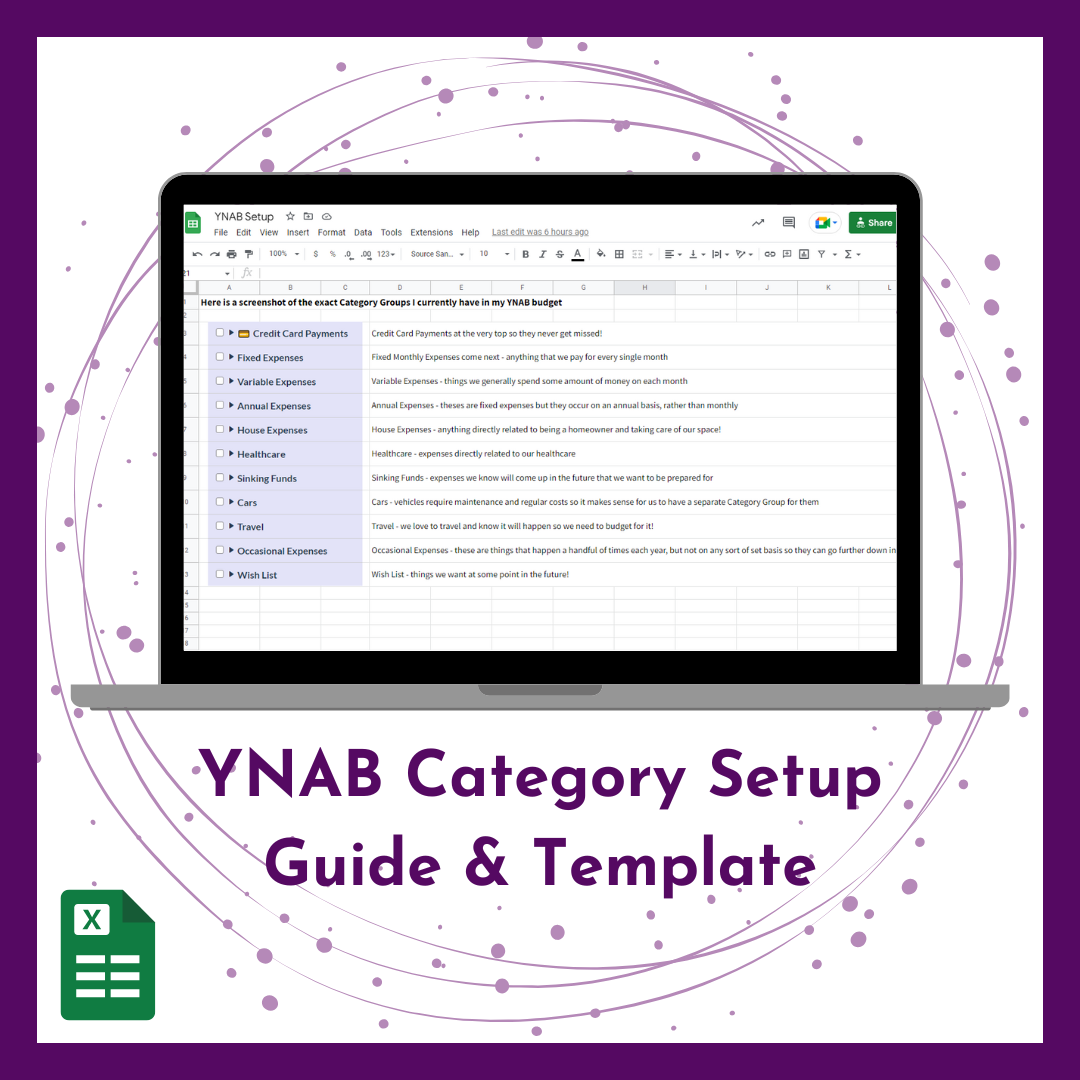
Of course, that link will be in the show notes for you as well. Go ahead and grab that if you’re just getting started, or check out Ally through my affiliate link below. All right, thanks so much for joining me on another episode of the Money Clarity Podcast. And remember: your biggest, wildest dreams are within reach. Let’s go make some money moves so that you, too, can start to experience financial freedom!
RESOURCES MENTIONED IN THIS EPISODE:
YNAB Category Setup Guide and Template
---
❇️ Join The Empowered Money Circle on Skool! ❇️
🟪 BLOG
➡️ Try YNAB for FREE for 34 days (affiliate link)
---
DISCLOSURES
By using the affiliate links above, I may earn a small commission if you decide to purchase anything. Thank you for your support :-)
YNAB Disclosure: I am a YNAB Certified Coach, which means that I have been trained to coach people on using YNAB software and the YNAB budgeting method. I have met select requirements of You Need a Budget LLC in order to receive this certification, which means that I have the ability to competently coach YNAB to others. I am not an employee of YNAB, and all non-YNAB related opinions and recommendations are my own. My views do not reflect the views of YNAB and its employees or affiliates.
Subscribe to The Money Clarity Podcast in your favorite podcast app!